If you’ve ever been responsible for a production line that handles powders, granules, or blended raw materials, you probably already know one thing: mixing is never just “mixing.”
It directly affects product consistency, downstream processing stability, and even how much material gets wasted during production.
That’s why the horizontal mixing machine has become a standard choice in so many industrial setups. Not because it looks advanced on paper, but because in real production environments, it simply does the job in a more controlled and repeatable way.
As a manufacturer working closely with different industrial applications, we often see the same situation: companies don’t struggle with the idea of mixing—they struggle with choosing the right configuration for their actual material behavior.
This article breaks the topic down in a more practical way, without overcomplicating it, and focuses on what actually matters in daily production.
Table of Contents
When “Mixing” Becomes a Production Problem

On paper, mixing sounds simple. In reality, it rarely is.
Different materials behave differently inside a mixing chamber:
- Some flow freely
- Some stick to surfaces
- Some separate during discharge
- Some require longer cycles just to reach uniformity
This is where many production lines start to lose efficiency—not because of operator error, but because the mixing principle doesn’t match the material characteristics.
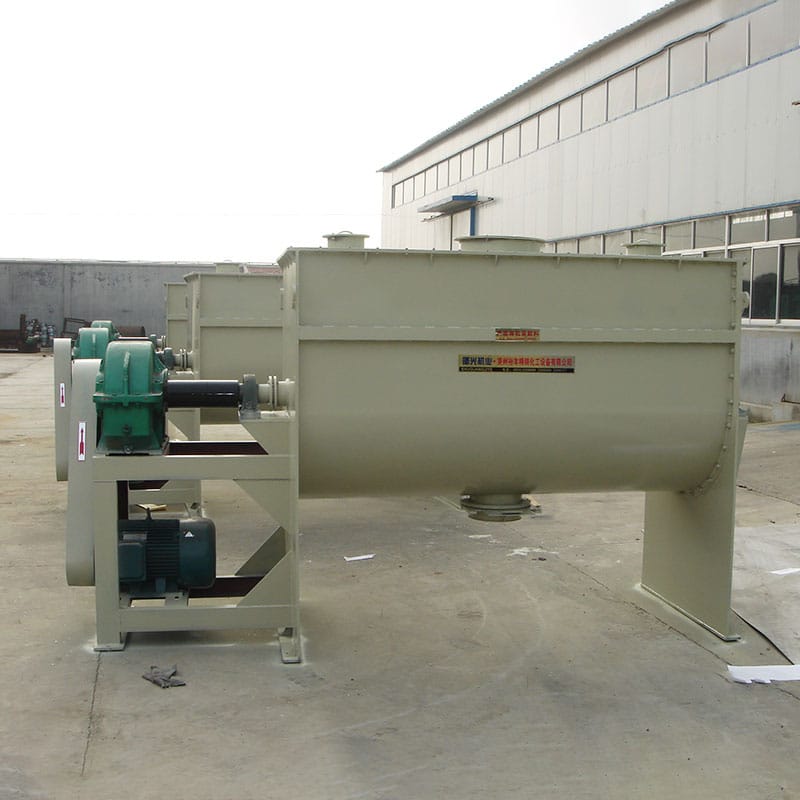
A horizontal mixing machine solves part of this problem by forcing materials into a controlled circulation pattern instead of relying on gravity alone.
What Actually Happens Inside a Horizontal Mixing Machine
Instead of thinking in mechanical terms first, it’s easier to picture the movement.
Inside the mixing chamber, two opposing forces are constantly working:
- One pushes material outward from the center
- The other pulls material back inward
This continuous counter-flow movement creates a loop where material is constantly being redistributed.
It’s not a random tumbling effect. It’s structured circulation.
That’s also why horizontal ribbon-style systems are widely used in powder industries—they don’t just “move” material, they keep reorganizing it.
In practice, this means:
- fewer unmixed zones
- more consistent batch results
- better control over blending time
Why Horizontal Design Matters More Than It Looks
A common misunderstanding is that the shape of the machine is just structural.
In reality, the horizontal layout changes how material behaves completely.
Because the chamber is not vertical:
- material is not relying on gravity to fall and mix
- movement is driven mechanically, not passively
- layering effects are reduced
This becomes especially important when working with materials that have different densities. In vertical systems, heavier particles tend to settle. In horizontal systems, they are continuously reintroduced into the mixing cycle.
That difference alone is often what decides whether a batch is stable or inconsistent.
Types of Horizontal Mixing Machines You’ll Actually See in Industry
Instead of listing textbook categories, it’s more useful to think in terms of how they behave in real production.
You’ll typically encounter:
Ribbon-based systems
These are commonly used for dry powders and general blending tasks where uniformity is the priority.
Paddle-style systems
Better suited for materials that are heavier, slightly sticky, or require more aggressive movement.
Batch processing systems
Used when production needs controlled cycles and consistent repeatability.
Continuous flow systems
Used in higher-output environments where material is constantly fed and discharged.
Each design exists because one single structure cannot efficiently handle all material behaviors.
What Actually Defines a “Good” Mixing Machine
In real production environments, performance is not judged by design drawings—it’s judged by stability over time.
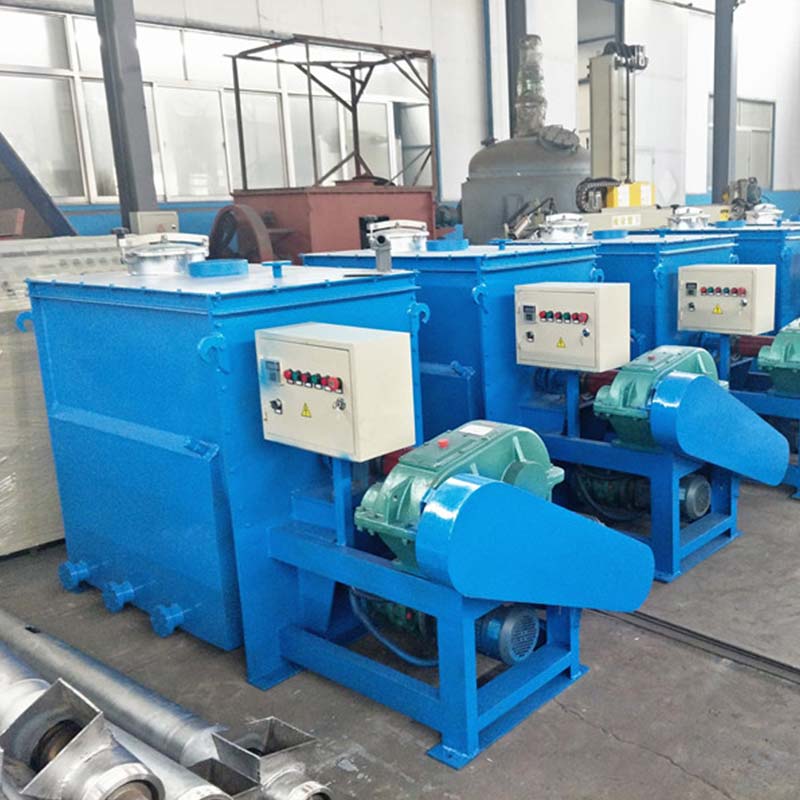
A reliable horizontal mixing machine usually shows the following characteristics:
It doesn’t leave obvious unmixed zones after a cycle
It doesn’t require constant operator adjustment
It behaves consistently across batches
It handles material variations without drastic performance changes
It discharges cleanly without excessive residue
One overlooked factor is how the machine behaves after months of continuous operation. Initial performance is easy to achieve. Stability over time is what separates designs.
Horizontal vs Vertical Mixing: The Practical Difference Nobody Talks About
Most comparisons focus on structure. In actual production, the difference shows up in behavior.
Horizontal systems tend to:
- handle wider material variations
- maintain more stable blending results
- reduce dependency on gravity behavior
Vertical systems often rely more on material falling and redistribution, which works well in certain cases—but becomes less predictable when materials vary in density or cohesion.
That’s why many production lines eventually switch to horizontal configurations after scaling up.
Where Horizontal Mixing Machines Are Actually Used
Instead of listing industries in isolation, it’s better to look at the pattern:
Any production line that handles bulk solid blending will eventually reach a point where consistency becomes critical.
That’s where horizontal systems are commonly found:
- powder-based food production lines
- chemical formulation processes
- fertilizer blending systems
- plastic and polymer mixing workflows
- detergent and cleaning powder production
- construction material preparation stages
The shared requirement is not the industry—it’s the need for repeatable uniformity.
Choosing the Right Configuration (What Usually Gets Overlooked)
Most selection mistakes don’t come from wrong equipment—they come from incomplete evaluation.
A few things that matter more than people expect:
Material behavior under motion, not just in static form
How the material reacts during discharge
Whether the batch size changes frequently
Whether the production line requires frequent cleaning
Whether the material is sensitive to heat or friction
In many cases, the machine is not the problem—the mismatch between material and mixing motion is.
Maintenance Is Not Optional (But It’s Often Treated That Way)
Even well-designed equipment will gradually lose performance if maintenance is ignored.
What matters in real operation is simple:
Keeping internal surfaces clean enough to avoid buildup
Checking movement components for wear before failure occurs
Ensuring consistent lubrication of drive systems
Monitoring vibration changes over time
Observing whether mixing time starts to increase gradually
Most performance issues appear slowly, not suddenly. That’s why they are often ignored until output quality changes noticeably.
Why Direct Manufacturer Input Changes the Outcome
One thing often underestimated in industrial equipment selection is engineering communication.
When working directly with a manufacturer, the focus is usually not just on supplying a machine, but on adjusting:
- internal structure design
- material selection for specific environments
- mixing intensity based on real behavior
- discharge configuration based on workflow
This is where customization matters—not as a feature, but as a requirement for stable production.
Conclusion
A horizontal mixing machine is not just a piece of industrial equipment sitting in a production line. It is part of the system that determines whether your material behaves consistently or unpredictably.
The key is not choosing the most complex model, but choosing a structure that matches how your material actually moves, blends, and discharges.
In most real production environments, stability matters more than anything else. Once the mixing process becomes predictable, everything downstream becomes easier to control.
And that is usually where production efficiency quietly improves—not through dramatic changes, but through better control of something that was already happening every day inside the mixer.
FAQ
Q1: What is a horizontal mixing machine used for?
A horizontal mixing machine is mainly used for blending powders, granules, and semi-dry materials in industries such as food processing, chemicals, pharmaceuticals, and construction materials production.
Q2: How does a horizontal mixing machine work?
It works by using a horizontal mixing chamber with ribbon or paddle agitators that create a continuous counter-flow movement, ensuring materials are repeatedly circulated and evenly blended.
Q3: What materials can be processed in a horizontal mixing machine?
It can handle dry powders, granular materials, and some semi-moist mixtures, depending on the machine configuration and industrial application requirements.
Q4: What is the difference between a horizontal and vertical mixing machine?
A horizontal mixing machine uses forced mechanical circulation for blending, while vertical systems rely more on gravity. Horizontal designs usually provide more stable and uniform mixing results for industrial production.
Q5: How often should a horizontal mixing machine be maintained?
Regular maintenance is recommended based on operating frequency, including routine cleaning, inspection of mixing blades, lubrication of moving parts, and monitoring of overall machine performance to ensure stable operation.