Table of Contents
Introduction
In modern industrial production, mixing is not only about combining materials. For many manufacturers, the real challenge is achieving stable dispersion, uniform particle distribution, consistent viscosity, and reliable batch-to-batch quality. This is especially important in industries such as paint, coatings, ink, adhesives, resin, pigment paste, chemical slurry, cosmetics, and other liquid-solid processing applications.
High speed dispersion mixers are widely used because they can quickly break down agglomerates, disperse powders into liquids, improve material uniformity, and shorten production time. For factories that handle pigments, fillers, resins, additives, emulsions, and high-viscosity materials, choosing the right equipment can directly affect product quality, production efficiency, and long-term operating cost.
As a manufacturer of high speed dispersion mixers, we understand that buyers are not only looking for a machine. They are looking for a practical mixing solution that matches their material properties, production capacity, safety requirements, and future expansion plans. This guide explains how to choose the right high speed dispersion mixer for industrial production and what factors should be considered before requesting a quotation.
What Are High Speed Dispersion Mixers?
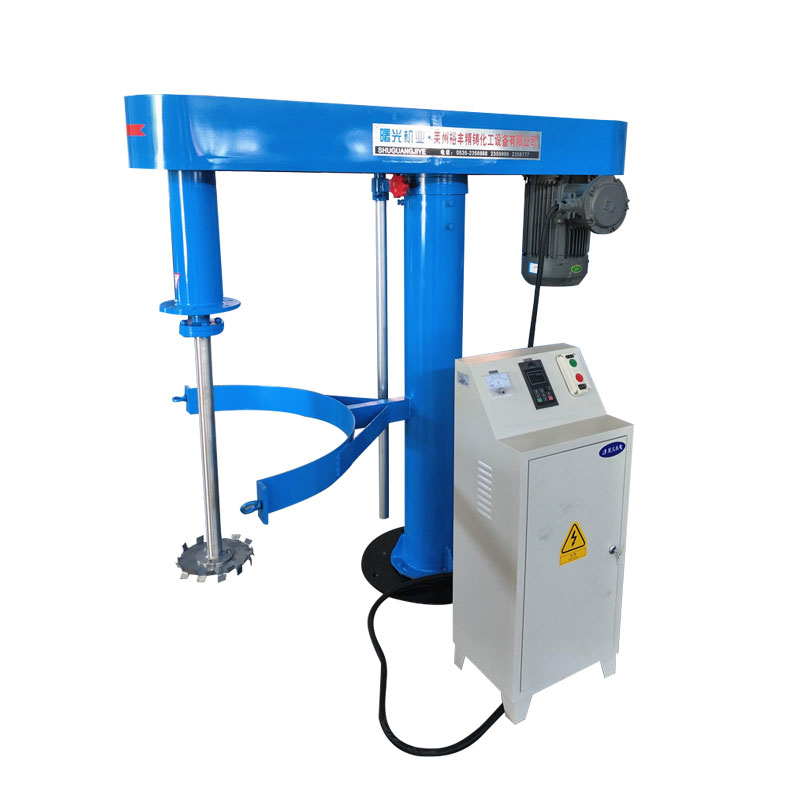
High speed dispersion mixers are industrial mixing machines designed to generate strong shear force through a high-speed rotating dispersion disc or blade. The rotating blade creates intense material movement inside the mixing tank, pulling solids and liquids into the high-shear zone and helping powders, pigments, fillers, and additives become evenly distributed in the liquid phase.
Unlike ordinary low-speed agitators, high speed dispersers are mainly used for dispersion rather than simple blending. They are especially suitable for materials that require particle wetting, deagglomeration, emulsification assistance, and uniform suspension.
Common materials processed by high speed dispersion mixers include:
- Paint and architectural coatings
- Industrial coatings and protective coatings
- Printing ink and pigment paste
- Adhesives and sealants
- Resin systems and emulsions
- Chemical slurry and liquid-solid mixtures
- Putty, fillers, and construction chemicals
- Cosmetic creams and personal care formulations
For many production lines, a high speed disperser is used during the pre-mixing or dispersion stage before further processing, filling, grinding, or packaging.
Why High Speed Dispersion Mixers Matter in Industrial Production
Industrial production requires repeatable results. If the mixing process is unstable, the final product may suffer from poor color consistency, uneven texture, sedimentation, low gloss, weak adhesion, poor flowability, or reduced storage stability.
High speed dispersion mixers help solve these problems by improving the way solid particles are introduced and dispersed into liquid systems. During operation, the blade creates a strong vortex and high-shear area, allowing powders to be quickly wetted and distributed.
For paint and coating manufacturers, this means better color development, smoother texture, and improved covering power. For adhesive and sealant producers, it helps improve material uniformity and bonding performance. For chemical processing plants, it supports more stable slurry preparation and better production efficiency.
Another major benefit is time saving. Compared with manual mixing or low-speed mixing equipment, high speed dispersion mixers can significantly shorten the production cycle. This allows factories to increase output, reduce labor dependency, and improve production planning.
Key Applications of High Speed Dispersion Mixers
High speed dispersion mixers are widely used across different industries because they can handle a broad range of liquid-solid mixing tasks. The following application areas are especially common.
High Speed Dispersion Mixers for Paint Production
Paint manufacturing requires accurate dispersion of pigments, fillers, resins, solvents, water, and additives. If pigment particles are not properly dispersed, the paint may show color difference, poor hiding power, unstable viscosity, or surface defects after application.
A high speed dispersion mixer helps break apart pigment agglomerates and distribute particles evenly throughout the liquid system. It is commonly used for water-based paint, latex paint, industrial paint, anti-corrosion coatings, and architectural coatings.
High Speed Dispersion Mixers for Coatings
Coating production often requires stable dispersion performance and controlled viscosity. Different coating formulas may include resins, pigments, fillers, functional powders, and chemical additives. A suitable coating dispersion mixer can improve product consistency and help achieve better film-forming performance.
For solvent-based coatings or flammable materials, explosion-proof high speed dispersion mixers are often recommended to improve operational safety.
High Speed Dispersion Mixers for Ink Manufacturing
Ink production requires fine pigment dispersion and stable color performance. Poor dispersion can affect printing quality, color strength, gloss, and storage stability. High speed dispersers are commonly used in the preparation of pigment paste, printing ink, packaging ink, and specialty ink systems.
High Speed Dispersion Mixers for Adhesives and Sealants
Adhesives and sealants often have higher viscosity than paint or ink. These materials may require stronger motor power, better torque, hydraulic lifting, and sometimes dual-shaft mixing structures. For medium to high-viscosity materials, a high speed dispersion mixer with a scraper or low-speed agitator can improve material circulation and prevent dead zones in the tank.
High Speed Dispersion Mixers for Chemical Slurry
Chemical slurry processing usually involves powder-liquid mixing, suspension preparation, and uniform distribution of solid particles. High speed dispersion mixers can be customized for corrosion resistance, tank volume, blade design, sealing structure, and special production requirements.
How High Speed Dispersion Mixers Work
The working principle of high speed dispersion mixers is based on mechanical shear and strong material circulation. When the dispersion disc rotates at high speed, it creates a powerful flow pattern inside the tank. Materials are pulled into the center of the blade and then thrown outward at high velocity.
This movement creates several important effects:
- Solid particles are quickly wetted by the liquid phase
- Powder agglomerates are broken apart by shear force
- Materials circulate continuously from top to bottom
- The mixture becomes more uniform over time
- Dispersion quality improves as particles are distributed evenly
However, higher speed does not always mean better dispersion. The best result depends on the balance between blade speed, material viscosity, tank size, batch volume, dispersion time, and formulation properties.
For example, low-viscosity materials may require controlled speed to avoid excessive splashing or foaming. High-viscosity materials may need stronger power and better flow assistance. Some materials may also require cooling jackets because high-speed shear can generate heat during operation.
Main Types of High Speed Dispersion Mixers
Different production needs require different machine structures. Choosing the right type of high speed disperser is one of the most important steps before purchasing.
Laboratory High Speed Dispersion Mixers
Laboratory models are suitable for formula testing, research and development, small-batch sampling, and quality control. They are commonly used by paint laboratories, ink research centers, adhesive development teams, and chemical testing facilities.
These machines usually feature compact structure, precise speed control, easy operation, and small-batch flexibility.
Hydraulic Lifting High Speed Dispersion Mixers
Hydraulic lifting models are widely used in industrial production. The mixing head can move up and down through a hydraulic system, making it easier to replace tanks, clean blades, and handle different batch sizes.
This type is popular in paint, coating, ink, resin, and adhesive production because it offers good efficiency and convenient operation.
Single Shaft High Speed Dispersion Mixers
Single shaft machines are suitable for low to medium-viscosity materials. They are commonly used for paint, coatings, ink, pigment paste, emulsions, and general chemical mixing.
Their structure is simple, efficient, and cost-effective, making them a common choice for many factories.
Dual Shaft High Speed Dispersion Mixers
Dual shaft mixers combine high-speed dispersion with low-speed mixing or scraping. They are more suitable for higher-viscosity materials where a single dispersion disc may not create enough overall circulation.
This design is often used for adhesives, sealants, resin systems, putty, and thick slurry materials.
Explosion-Proof High Speed Dispersion Mixers
Explosion-proof models are designed for flammable or solvent-based production environments. They may include explosion-proof motors, electrical control systems, sealed structures, and safer operating designs.
For coating, ink, resin, and chemical plants handling solvents, explosion-proof design should be carefully considered.
How to Choose the Right High Speed Dispersion Mixers
Choosing high speed dispersion mixers should not be based only on price or appearance. The right machine depends on actual production requirements. Before selecting a model, buyers should evaluate the following factors.
Check Your Material Viscosity
Viscosity has a direct influence on motor power, blade design, tank structure, and mixing efficiency. Low-viscosity materials are easier to circulate, while high-viscosity materials require stronger power and better mechanical support.
If your material is very thick, sticky, or paste-like, a dual shaft dispersion mixer or customized mixing system may be more suitable.
Confirm Your Batch Capacity
Batch capacity determines tank size, machine height, lifting stroke, blade diameter, and motor power. A laboratory model may handle only a few liters, while industrial high speed dispersion mixers can process hundreds or thousands of liters per batch.
Before requesting a quotation, it is helpful to know your expected batch volume, daily output, and future production expansion needs.
Choose the Right Motor Power
Motor power affects shear strength, processing ability, and long-term stability. If the motor is too small, the machine may struggle with high-viscosity materials or large batches. If the motor is too large, it may increase unnecessary energy consumption and equipment cost.
A professional manufacturer can recommend suitable motor power based on material viscosity, tank volume, and production process.
Select Proper Speed Control
Variable speed control is important for many production processes. During powder feeding, lower speed may help reduce splashing and dust. During dispersion, higher speed may be needed to create stronger shear force. During final adjustment, controlled speed helps stabilize viscosity and avoid over-processing.
A frequency inverter or adjustable speed system gives operators more control over the mixing process.
Consider Tank Design and Material
The tank can be fixed, movable, stainless steel, jacketed, vacuum-sealed, or customized according to the application. Stainless steel 304 is commonly used for many industrial materials, while stainless steel 316L may be preferred for more corrosive or hygienic applications.
For temperature-sensitive materials, a heating or cooling jacket can be added. For foaming materials, a vacuum cover may help reduce air entrainment.
Evaluate Safety Requirements
Safety should never be ignored in industrial production. Depending on the material, safety features may include emergency stop buttons, protective covers, explosion-proof motors, electrical safety systems, limit switches, and stable lifting structures.
If the material contains solvents or flammable components, explosion-proof configuration should be discussed before purchasing.
High Speed Dispersion Mixers Selection Guide
The table below provides a practical reference for matching mixer types with different applications.
| Application | Material Type | Recommended Mixer Type | Key Features to Consider |
|---|---|---|---|
| Paint production | Pigments, fillers, resins, water or solvent | Hydraulic lifting high speed disperser | Variable speed, stainless steel contact parts, strong shear blade |
| Coating manufacturing | Water-based or solvent-based coatings | Industrial or explosion-proof high speed dispersion mixer | Explosion-proof option, stable speed control, sealed design |
| Ink production | Pigment paste, resin, additives | High speed disperser with precise control | Fine dispersion, easy cleaning, stable operation |
| Adhesives | Medium to high-viscosity materials | Dual shaft dispersion mixer | High torque, scraper option, hydraulic lifting |
| Chemical slurry | Powder-liquid mixtures, suspensions | Customized industrial dispersion mixer | Corrosion resistance, custom tank, strong circulation |
| Laboratory testing | Small-batch formulas | Laboratory high speed dispersion mixer | Compact design, precise speed adjustment, easy operation |
| Resin production | Resin, fillers, additives | Heavy-duty high speed disperser | Strong motor, durable shaft, heating or cooling option |
| Cosmetic materials | Cream, lotion, emulsion | Stainless steel dispersion mixer | Hygienic design, smooth surface, optional vacuum system |
Important Technical Specifications Buyers Should Compare
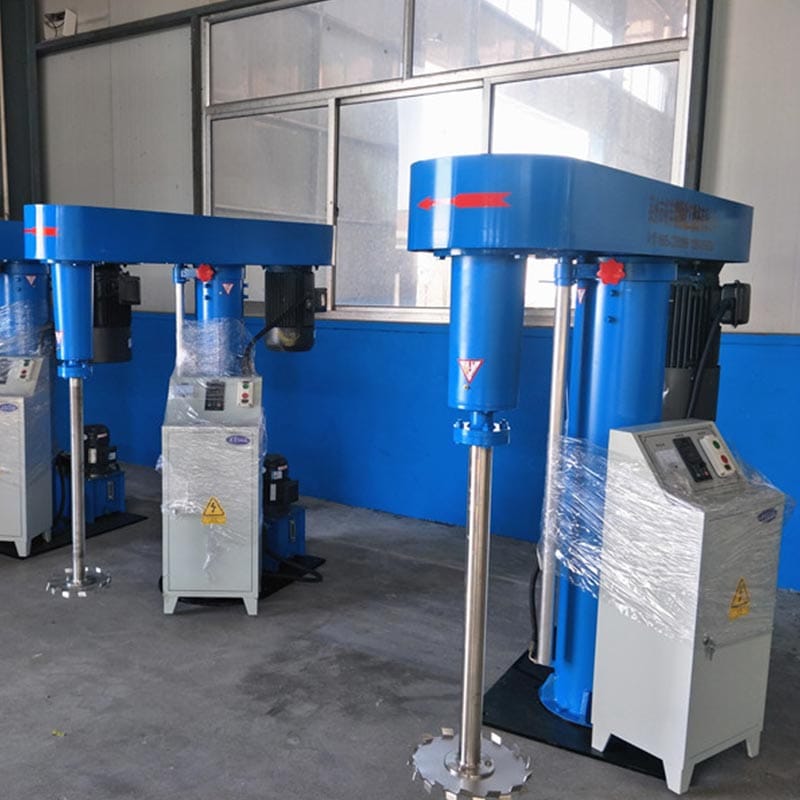
When comparing high speed dispersion mixers from different suppliers, technical specifications should be reviewed carefully. A machine with similar appearance may perform very differently depending on its structure and configuration.
Motor Power
Motor power should match material viscosity and batch size. For industrial production, insufficient power may lead to poor dispersion, longer processing time, and higher mechanical stress.
Rotation Speed
Rotation speed affects shear intensity and dispersion performance. The ideal speed depends on the formula, material thickness, particle size, and required final quality. Adjustable speed is usually more practical than fixed speed.
Blade Diameter
The dispersion blade must be properly matched with the tank diameter and batch volume. If the blade is too small, circulation may be weak. If it is too large, it may overload the motor or create unstable flow.
Lifting Stroke
For hydraulic lifting high speed dispersion mixers, the lifting stroke affects tank replacement, cleaning, operation convenience, and production flexibility.
Contact Material
The parts that contact the material should be selected according to corrosion resistance, hygiene requirements, and product characteristics. Stainless steel 304 and 316L are common options.
Control System
A reliable control system improves operation stability. Depending on production needs, the machine can include variable frequency control, digital speed display, timing function, safety interlock, and customized electrical cabinet.
High Speed Dispersion Mixers vs Other Mixing Equipment
Many buyers compare high speed dispersion mixers with other types of mixing machines before making a purchase decision. Understanding the differences can help avoid wrong equipment selection.
High Speed Dispersion Mixers vs Low Speed Agitators
Low-speed agitators are mainly used for simple blending and maintaining suspension. They are suitable for materials that do not require strong shear. High speed dispersion mixers, on the other hand, are designed for stronger dispersion, powder wetting, and particle deagglomeration.
If your process only requires gentle mixing, a low-speed agitator may be enough. If your process involves pigments, fillers, powders, or agglomerates, a high speed disperser is usually more suitable.
High Speed Dispersion Mixers vs High Shear Mixers
Both machines can generate shear force, but their structures and applications may differ. High shear mixers are often used for emulsification, homogenization, and fine mixing, while high speed dispersers are widely used for pigment dispersion, paint production, and powder-liquid mixing.
The right choice depends on whether your main goal is dispersion, emulsification, particle size reduction, or general mixing.
High Speed Dispersion Mixers vs Bead Mills
A bead mill is mainly used for fine grinding and particle size reduction after pre-dispersion. In many paint, ink, and pigment production lines, high speed dispersion mixers are used first to prepare the material, and then bead mills are used for further grinding.
For some products, a high speed disperser alone may be enough. For very fine particle requirements, bead milling may be needed after dispersion.
High Speed Dispersion Mixers vs Planetary Mixers
Planetary mixers are often used for very high-viscosity pastes and materials that require strong kneading or scraping. High speed dispersion mixers are better for materials requiring fast shear, powder dispersion, and liquid-solid mixing.
For high-viscosity adhesives or sealants, a combined dual shaft system may be a better solution.
Common Problems in High Speed Dispersion Mixing
Even with the right equipment, process problems may occur if the machine is not properly selected or operated.
Powder Floating on the Surface
Powder floating usually happens when the feeding speed is too fast, the liquid vortex is not strong enough, or the blade position is not suitable. Adjusting the feeding method, blade height, and rotation speed can help powders enter the liquid more effectively.
Poor Pigment Dispersion
Poor pigment dispersion may be caused by insufficient shear force, short mixing time, wrong blade size, unsuitable wetting agents, or incorrect process sequence. For pigment-heavy formulas, equipment selection and formula design should be considered together.
Excessive Foaming
High-speed mixing can introduce air into the material, especially in formulas containing surfactants or foaming agents. Speed control, vacuum design, anti-foam additives, or improved feeding methods can help reduce foam.
Overheating During Mixing
Strong shear can generate heat. Some materials may become unstable if the temperature rises too much. In this case, a cooling jacket, controlled speed, or staged mixing process may be needed.
Uneven Batch Quality
Uneven quality can result from poor circulation, wrong tank size, inconsistent operation, or unsuitable machine configuration. A well-designed high speed dispersion mixer should create stable material movement and repeatable dispersion results.
Why Work with a High Speed Dispersion Mixer Manufacturer?
Buying directly from a manufacturer offers several advantages, especially for industrial buyers with specific production needs.
As a manufacturer, we can provide equipment recommendations based on your material type, viscosity, batch capacity, safety requirements, and factory layout. Instead of offering only standard models, we can customize the machine structure to better match your actual process.
Common customization options include:
- Tank volume and tank material
- Motor power and speed range
- Hydraulic lifting system
- Explosion-proof configuration
- Stainless steel 304 or 316L contact parts
- Heating or cooling jacket
- Vacuum cover
- Blade type and blade diameter
- Control panel and automation level
- Fixed or movable tank design
- Single shaft or dual shaft structure
For paint factories, coating plants, ink manufacturers, adhesive producers, and chemical companies, customized equipment can improve production efficiency and reduce long-term operating problems.
Working with a manufacturer also makes technical communication easier. Buyers can discuss material details directly with the engineering team, receive more practical suggestions, and get better support for installation, operation, and spare parts.
Buying Tips Before Requesting a Quotation
Before contacting a supplier or manufacturer, preparing basic process information can help you receive a more accurate recommendation and quotation.
You may need to provide:
- Material name and application industry
- Approximate viscosity
- Solid content or powder ratio
- Batch capacity
- Daily production output
- Required final fineness or dispersion quality
- Whether the material is flammable or solvent-based
- Whether heating, cooling, or vacuum is required
- Available factory space and power supply
- Preferred tank type and material
It is also important not to choose equipment only by price. A lower-cost machine may look attractive at first, but poor motor quality, weak structure, thin stainless steel, unstable lifting, or limited safety design can create higher costs later.
A reliable high speed dispersion mixer should offer stable performance, safe operation, easy maintenance, and a long service life.
Maintenance Tips for Long-Term Performance
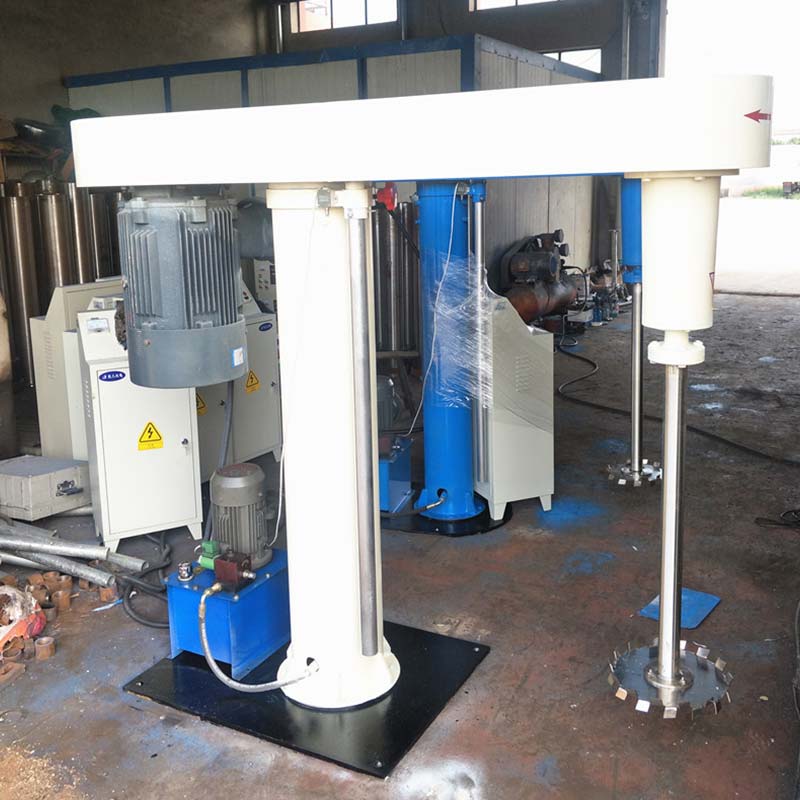
Proper maintenance helps extend machine life and maintain stable dispersion quality.
After each production batch, the blade, shaft, and tank should be cleaned in time to prevent material residue from drying or hardening. Operators should also check whether bolts, bearings, electrical parts, and hydraulic components are working normally.
The dispersion blade should be inspected regularly. If the blade is worn, bent, or damaged, the shear effect may decrease, leading to longer mixing time and poorer product quality.
For hydraulic lifting models, the lifting system should be checked for smooth movement and oil leakage. For explosion-proof equipment, electrical safety should be inspected according to factory safety requirements.
Regular maintenance is not complicated, but it can prevent unexpected downtime and improve long-term production reliability.
Conclusion
Choosing the right high speed dispersion mixers for industrial production requires more than comparing machine prices. A suitable mixer should match your material viscosity, batch capacity, application industry, safety standards, and long-term production goals.
For paint, coatings, ink, adhesives, resin, pigment paste, and chemical slurry production, high speed dispersion mixers can improve dispersion efficiency, reduce mixing time, enhance product consistency, and support stable industrial manufacturing.
As a high speed dispersion mixer manufacturer, we provide practical equipment solutions for different industries and production scales. If you are planning a new production line or upgrading your current mixing process, you can share your material type, viscosity, batch volume, and application requirements with our team. We can help you choose a suitable model and provide a customized solution for your production needs.
FAQ
What are high speed dispersion mixers used for?
High speed dispersion mixers are used for dispersing, mixing, and homogenizing solid particles into liquid systems. They are commonly applied in paint, coatings, ink, adhesives, resin, pigment paste, chemical slurry, emulsions, and other industrial materials.
How do I choose the right high speed dispersion mixer?
You should choose based on material viscosity, batch capacity, motor power, blade type, speed control, safety requirements, and production process. If the material is high-viscosity or solvent-based, customized design may be required.
Can high speed dispersion mixers handle high-viscosity materials?
Yes, but the equipment must be properly configured. High-viscosity materials may require stronger motor power, a larger shaft, hydraulic lifting, dual shaft mixing, scraper design, or customized tank structure.
What is the difference between a high speed disperser and a normal mixer?
A normal mixer mainly blends materials, while a high speed disperser creates strong shear force to break down agglomerates and disperse powders or particles into liquids more effectively.
Can high speed dispersion mixers be customized?
Yes. As a manufacturer, we can customize tank volume, motor power, blade type, contact material, lifting system, explosion-proof design, cooling jacket, vacuum cover, and control system according to different production requirements.