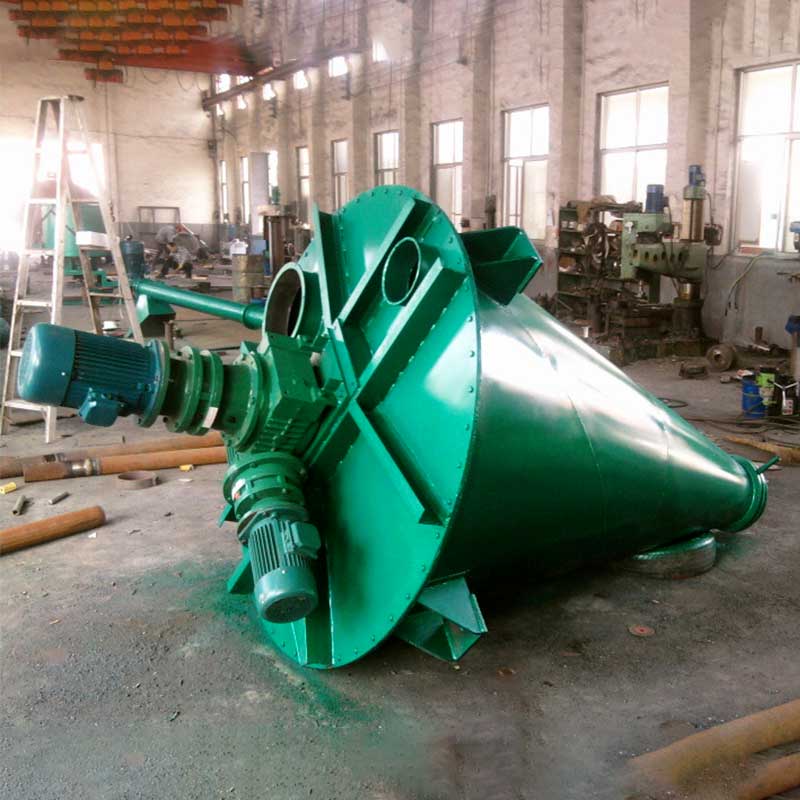
Not all powder mixing problems are caused by poor formulations.
In many production facilities, the real issue lies in the mixing process itself.
A batch may pass laboratory testing one day and fail the next. Operators may increase mixing time, adjust raw material ratios, or even change suppliers, yet the inconsistency remains. In many cases, the root cause is that the mixing equipment is not moving materials in the way the process actually requires.
This is one reason why more manufacturers are replacing conventional powder blending systems with a conical powder mixer.
The equipment is no longer limited to pharmaceutical production. Today it is widely used in food processing, specialty chemicals, battery materials, mineral powders, nutritional supplements, and many other industries where blend quality directly affects product performance.
Before choosing a powder mixer, it helps to understand why the conical design has become increasingly popular.
Table of Contents
A Common Problem Most Powder Manufacturers Eventually Face
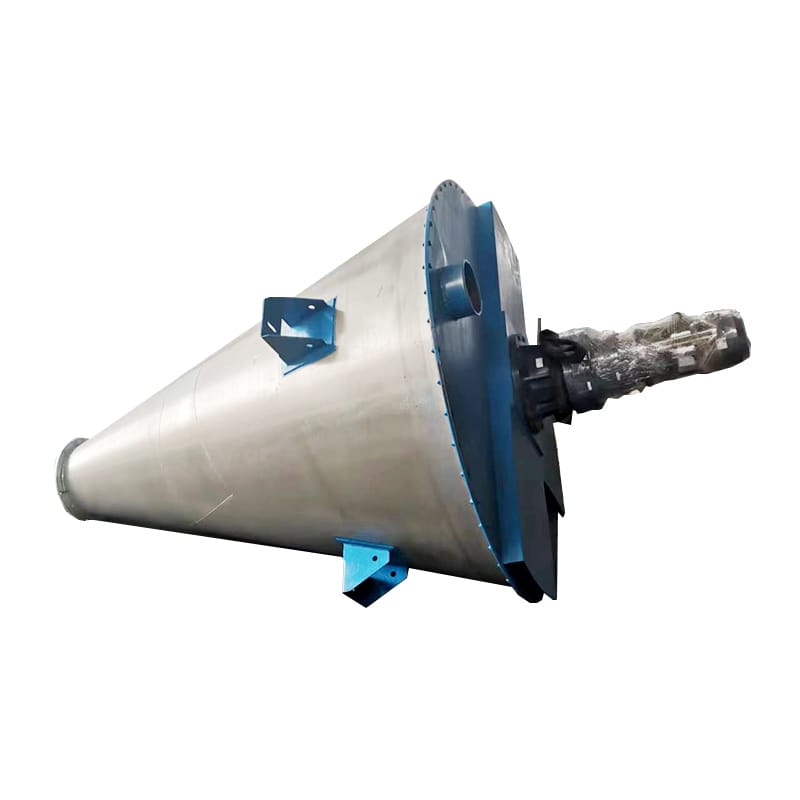
Imagine a production line blending several powdered ingredients.
One material flows easily.
Another is extremely fine.
A third has a significantly higher bulk density.
At first glance, the ingredients appear fully mixed. However, samples taken from different locations in the batch often tell a different story.
This issue becomes more noticeable when:
- The formulation contains trace ingredients
- Particle sizes vary significantly
- The product is sensitive to segregation
- Batch consistency is critical
Traditional mixing systems can struggle under these conditions because materials tend to follow predictable flow paths.
A conical powder mixer was developed to solve this challenge.
What Makes a Conical Powder Mixer Different?
The answer is surprisingly simple.
Instead of forcing powders through a horizontal mixing chamber, a conical powder mixer uses gravity as part of the mixing process.
The mixing vessel is shaped like a cone, allowing materials to move naturally while a vertical screw continuously lifts product upward.
As material reaches the upper region of the vessel, gravity pulls it back down.
This movement repeats throughout the entire batch.
Rather than creating a few active mixing zones, the system encourages movement throughout the full volume of the vessel.
The result is a more complete and balanced blending process.
Inside the Mixing Chamber: What Actually Happens?
Many articles describe powder mixing using technical terminology.
A more practical explanation is easier to visualize.
During operation, the screw lifts material from the bottom of the cone.
As the screw rotates around the vessel, it continuously changes position.
This creates three simultaneous actions:
✓ Vertical lifting
✓ Radial movement
✓ Gravity-driven circulation
Because powders travel through multiple paths rather than a single route, the entire batch becomes progressively more uniform.
This is especially important when working with:
- Fine powders
- Lightweight ingredients
- Sensitive materials
- Multi-component formulations
Why Pharmaceutical and Food Producers Often Prefer Conical Mixing
Some powders cannot tolerate aggressive mixing.
Excessive mechanical force can:
- Damage particle structure
- Affect flowability
- Cause unwanted heat generation
- Alter product characteristics
A conical powder mixer addresses this issue by using a gentler mixing mechanism.
Instead of relying primarily on impact or high-speed agitation, the equipment combines controlled mechanical movement with gravity.
For manufacturers producing high-value powders, preserving material integrity is often just as important as achieving blend uniformity.
When Does a Conical Powder Mixer Deliver the Greatest Advantage?
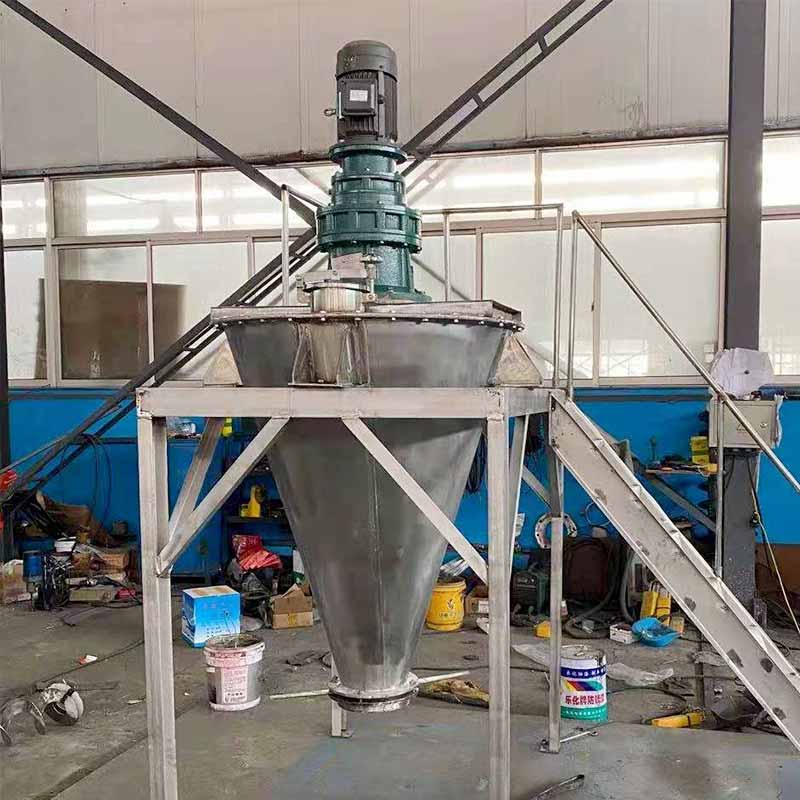
Not every powder blending application requires the same type of equipment.
However, conical mixing technology often performs exceptionally well when manufacturers need to process:
Formulations with Multiple Ingredients
As ingredient counts increase, achieving consistent distribution becomes more challenging.
The three-dimensional mixing pattern helps improve ingredient dispersion throughout the batch.
Powders with Different Bulk Densities
Materials that naturally separate during handling can often be blended more effectively in a conical vessel.
Fragile or Heat-Sensitive Materials
The gentle mixing action helps reduce particle damage.
Large Batch Volumes
The vertical design allows efficient processing while maintaining a relatively compact footprint.
Conical Powder Mixer vs Ribbon Blender: The Question Buyers Ask Most
Among all equipment comparisons, this is probably the most common.
The reality is that neither design is universally better.
The correct choice depends on the application.
A ribbon blender is often selected for high-throughput operations involving free-flowing materials.
A conical powder mixer is frequently chosen when product quality, blend precision, and gentle handling are priorities.
When evaluating powder mixing equipment, manufacturers should focus less on equipment popularity and more on process requirements.
The best mixer is the one that consistently produces the required product quality.
Signs That Your Existing Mixing Process May Need Improvement
Many manufacturers continue using outdated equipment simply because production is still running.
However, certain warning signs often indicate that the mixing process deserves closer attention:
- Batch-to-batch quality variation
- Increasing mixing times
- Frequent product segregation
- Excessive material residue
- Difficult cleaning procedures
- Growing production demands
When these issues become recurring problems, upgrading the mixing process often provides benefits beyond product quality alone.
The Growing Role of Conical Powder Mixers in Emerging Industries
A decade ago, powder mixing discussions were largely focused on pharmaceuticals and food production.
Today, new industries are driving demand for advanced powder processing equipment.
Examples include:
- Battery material manufacturing
- Functional ceramics
- New energy materials
- Specialty minerals
- High-performance additives
- Advanced composite materials
These applications often require a level of mixing precision that traditional systems struggle to achieve consistently.
As product formulations become more sophisticated, the importance of reliable powder blending technology continues to increase.
What Should Buyers Evaluate Before Selecting a Conical Powder Mixer?
Many purchasing decisions focus heavily on capacity.
Capacity matters, but it should never be the only consideration.
Experienced engineers typically evaluate several factors:
Material Characteristics
Particle size, density, moisture content, and flow behavior all influence mixer performance.
Production Objectives
The required level of blend uniformity should be clearly defined before equipment selection.
Cleaning Requirements
Industries with strict hygiene standards often require designs that support fast and thorough cleaning.
Future Expansion
Production volumes rarely stay the same forever.
Selecting equipment that supports future growth can prevent costly upgrades later.
Automation Requirements
Modern powder processing facilities increasingly integrate automated control systems to improve consistency and reduce operator intervention.
Looking Ahead: Where Powder Mixing Technology Is Going

Manufacturing is becoming smarter, more connected, and more data-driven.
Powder mixing equipment is evolving in the same direction.
Current trends include:
- Intelligent process monitoring
- Automated recipe management
- Real-time production data collection
- Improved energy efficiency
- Enhanced cleaning technologies
- Integration with smart factory systems
The objective is no longer simply mixing powders.
The objective is achieving repeatable product quality with greater operational efficiency.
Conclusion
A conical powder mixer is much more than a vessel with a screw agitator. Its design addresses some of the most common challenges found in industrial powder processing, including segregation, inconsistent blending, material degradation, and inefficient production workflows.
What makes the technology particularly valuable is its ability to combine gentle handling with high mixing efficiency. Whether the application involves pharmaceutical powders, food ingredients, specialty chemicals, or advanced materials, the conical mixing principle provides manufacturers with a practical solution for achieving reliable and repeatable results.
As industries continue demanding higher product quality and tighter process control, the conical powder mixer is likely to remain one of the most important technologies in modern powder blending operations.
FAQ
What is a conical powder mixer used for?
A conical powder mixer is used to blend powders, granules, and dry bulk materials uniformly in industries such as pharmaceuticals, food processing, chemicals, and advanced materials manufacturing.
How does a conical powder mixer improve mixing uniformity?
The mixer combines vertical lifting and gravity-assisted circulation, allowing materials to move throughout the entire vessel and achieve a more consistent blend.
What materials can be processed in a conical powder mixer?
A conical powder mixer can handle fine powders, granules, additives, nutritional ingredients, chemical powders, battery materials, and other free-flowing or semi-free-flowing bulk solids.
Is a conical powder mixer suitable for fragile materials?
Yes. The gentle mixing action helps minimize particle breakage and reduces the risk of damaging heat-sensitive or fragile materials during processing.
How do I choose the right conical powder mixer?
Key factors include material characteristics, batch size, required mixing accuracy, cleaning requirements, production capacity, and the level of automation needed for your operation.